The world’s largest sovereign wealth fund generated roughly $184 billion in the first half of 2026, powered by global equities and technology stocks — even as its chief executive warned that the economic conditions behind Norway’s extraordinary accumulation of wealth may not last.
OSLO — Norway’s sovereign wealth fund generated an accounting return of 1.753 trillion Norwegian kroner, or roughly $184 billion, in the first half of 2026, marking its highest half-year return in kroner on record.
The Government Pension Fund Global returned 9.4% over the period, outperforming its benchmark by 0.22 percentage points. Its value reached approximately $2.3 trillion, cementing its position as the world’s largest sovereign wealth fund.
The gains were overwhelmingly driven by equities, which returned 13%, with technology stocks — particularly in Asia — making a significant contribution to the result.
The performance underscores the extraordinary success of Norway’s sovereign wealth model. But it also highlights a developing challenge: while the fund remains diversified across thousands of companies, an increasing share of its wealth is tied to a relatively small group of global technology giants.
Big Tech Is Increasingly Important to Norway’s Wealth
The fund owns stakes in roughly 7,100 companies worldwide and, on average, about 1.5% of all publicly listed companies globally.
But the markets it tracks have become increasingly concentrated.
NBIM CEO Nicolai Tangen said the fund’s ten largest investments now account for roughly 20% of its total value, with technology companies dominating the group. Its major holdings include Nvidia, Apple, Alphabet, Microsoft and Taiwan Semiconductor Manufacturing Company. The fund held approximately $62 billion in Nvidia and $52 billion in Apple at the end of June.
It also disclosed for the first time a roughly $1.2 billion stake in SpaceX, acquired before the space company’s June stock-market debut.
The concentration reflects a broader transformation of global equity markets. Technology now represents roughly a third of the S&P 500, meaning large investors that track major market indices can become increasingly exposed to a handful of companies even while maintaining thousands of individual holdings.
For Norway, that creates an important distinction: the fund itself remains broadly diversified, but its economic exposure is increasingly influenced by the technology companies that dominate global market capitalization.
Record Returns Come With Rising Risk
The same technology cycle driving Norway’s gains is also emerging as a significant source of portfolio risk.
NBIM has been examining how its portfolio could perform under severe scenarios involving an AI-driven market correction, geopolitical fragmentation and other major disruptions. These exercises are stress tests rather than forecasts, but they illustrate how quickly losses could accumulate across a portfolio heavily exposed to global equities.
That vulnerability is inherent in Norway’s model. The fund invests the country’s oil and gas revenues predominantly outside Norway, with most of its portfolio tracking international market indices. Its extraordinary growth therefore connects Norwegian public wealth directly to the performance of global financial markets.
The fund’s investment strategy is also deliberately slow-moving. Significant changes to its mandate require political approval, limiting its ability to make rapid shifts in response to changing market conditions while protecting it from becoming a vehicle for short-term investment bets.
Tangen Warns Norway Against Assuming the Boom Will Continue
The record result came alongside a striking warning from Tangen about Norway’s assumptions regarding its own prosperity.
Speaking at Norway’s Arendalsuka political gathering, he argued that the environment in which the fund accumulated much of its wealth — characterized by relatively low inflation, interest rates and taxes — may have been historically unusual rather than a permanent economic condition.
The fund reached approximately $1 trillion in 2017 and has since more than doubled in value. But Tangen urged Norwegians to contemplate even extreme scenarios in which a severe global market collapse could sharply erode the fund’s value. His comments were framed as a call for economic preparedness, not a prediction that such a collapse is imminent.
The warning carries growing significance because the fund has become increasingly important to Norway’s public finances. It now supports roughly a quarter of public spending, compared with around 10% a decade ago.
Norway’s fiscal framework is designed to prevent the country from consuming its accumulated wealth too quickly, anchoring government withdrawals over time to the fund’s expected long-term real return. Yet as the fund has grown to several times the size of Norway’s domestic economy, movements in global financial markets increasingly carry consequences for national fiscal policy.
Financial Power Brings Governance Questions
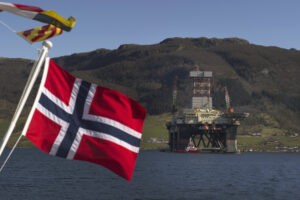
Norway created the fund to transform finite petroleum revenues into financial wealth capable of benefiting future generations. Three decades later, it has become not only the world’s largest sovereign wealth fund but also one of the most influential shareholders in global markets.
That scale brings responsibilities extending beyond investment returns.
NBIM exercises shareholder rights across thousands of companies, using its holdings to engage on corporate governance, board accountability, climate risk and other long-term financial considerations.
At the same time, Norway is reconsidering how its ethical-investment framework should operate. Parliament paused ethical divestments in November 2025 while the guidelines are reviewed, following growing international scrutiny over some company exclusions.
The debate points to a broader challenge confronting sovereign investors: as their portfolios grow, decisions about what they own — and what they refuse to own — can carry diplomatic and geopolitical consequences alongside financial ones.
From Building Wealth to Protecting It
Norway’s sovereign wealth model remains one of the world’s clearest examples of converting finite natural-resource revenues into intergenerational financial assets.
Its next challenge may be less about accumulating wealth than protecting it.
The fund must navigate increasingly concentrated equity markets, rapid technological change, geopolitical fragmentation and growing domestic reliance on investment returns — while preserving the governance discipline that helped make the model successful in the first place.
The record $184 billion first-half gain demonstrates the extraordinary power of Norway’s approach.
Tangen’s warning captures its next test: after successfully transforming oil wealth into global financial wealth, Norway must ensure that extraordinary past returns do not become an assumption about the future.
RELATED STORIES:
 Follow SDG News on LinkedIn