Exceptionally low water levels across major European waterways are disrupting shipping, agriculture and electricity generation, showing how water security is becoming a strategic economic issue for the continent.
Europe’s prolonged heat and drought are pushing some of its most important rivers to unusually low levels, turning a water crisis into a widening test of the continent’s energy systems, supply chains and economic resilience.
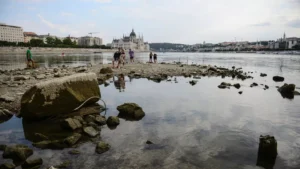
The Rhine and Danube — waterways connecting major industrial centers, agricultural regions and energy infrastructure — have fallen sharply after months of unusually hot and dry conditions. Italy’s Po and other major rivers are also under pressure.
The European Drought Observatory has described conditions across much of Europe as critical, while persistent heat has accelerated the loss of moisture from soils and waterways.
The result is increasingly visible far beyond the riverbanks.
The Rhine Is Turning Drought Into an Industrial Risk
The Rhine is one of Europe’s most important commercial arteries, carrying petroleum products, chemicals, minerals, grain and industrial materials between the North Sea and manufacturing centers farther inland.
Low water does not necessarily halt river traffic, but it can sharply reduce how much cargo vessels can safely carry. In July, some vessels navigating the strategically important stretch around Kaub, Germany, were operating at as little as 20% of normal capacity, while freight rates increased as companies required more vessels to move the same amount of cargo.
That turns a hydrological problem into an industrial one.
The Kiel Institute for the World Economy estimates that persistently low Rhine levels could reduce German economic output by as much as 0.2% in the third quarter, offering a tangible measure of how drought can translate into national economic performance.
Germany experienced a similar warning in 2018, when historically low Rhine levels disrupted chemical, steel and fuel supply chains. The recurrence of severe low-water episodes is now forcing companies to reconsider logistics networks, vessel design and alternative transport capacity.
Reuters reported this week that investors are increasingly treating heat, drought and wildfires as macroeconomic risks, with extreme weather feeding into food prices, transportation costs and supply-chain pressures at a time when European economies are already navigating weak growth and inflation concerns.
The Danube Shows the Link Between Water and Energy Security
The same water shortage is exposing a different vulnerability farther east.
Along the Danube, exceptionally low river levels are affecting electricity infrastructure that depends on reliable access to cooling water.
In Romania, low flows have forced one reactor at the Cernavoda nuclear power station offline, while authorities have taken emergency measures to preserve sufficient water for the remaining reactor. The facility normally generates around one-fifth of Romania’s electricity.
Hungary has faced similar pressure at the Paks nuclear power station, which ordinarily supplies close to half of the country’s electricity.
Drought can also constrain hydropower production, meaning the same weather event can reduce multiple sources of electricity at once.
That creates a regional challenge. Countries facing domestic shortages would normally turn to neighboring power markets, but simultaneous heat and drought can place generating capacity under pressure across several countries at the same time.
Water availability is therefore becoming an increasingly relevant part of European energy-security planning alongside fuel supplies, grid connectivity and storage.
Agriculture Faces the Same Constraint
Europe’s food system is being tested by the same dynamics.
European grain farmers are expected to lose roughly €2 billion in revenue from June’s heatwave, according to an estimate from European cereals and oilseeds trade association Coceral. The group projected that around 9 million tonnes of grain production could be lost across crops including wheat, barley, maize and oats.
Italy’s Po Valley illustrates how river decline can compound those pressures. The Po supports one of Europe’s most productive agricultural and food-processing regions, where low flows can restrict irrigation and allow saltwater from the Adriatic to move farther upstream.
Taken together, the disruptions show how drought can affect multiple parts of the economy simultaneously: waterways transporting commodities, water cooling power plants and irrigation systems supporting food production.
Heat Is Changing the Nature of Drought Risk
The current conditions are also highlighting an important shift in how drought develops.
Research from World Weather Attribution found that extreme heat has intensified this year’s drought by accelerating evaporation from soils, vegetation and waterways. The analysis concluded that human-caused climate change made drought conditions more severe across western and eastern Europe.
That matters because drought risk is not determined by rainfall alone.
Higher temperatures can rapidly reduce available water even after comparatively wet periods, making historical rainfall patterns a less reliable guide for infrastructure and water planning.
For governments, that means drought resilience increasingly requires preparing not only for prolonged periods without rain, but also for faster water loss during extreme heat.
Water Scarcity Is Forcing Harder Policy Choices
As supplies tighten, governments also face increasingly difficult decisions over who gets access to limited water.
Households, agriculture, industry, electricity generation and ecosystems all depend on the same resource, and demand from several sectors can peak simultaneously during hot weather.
The Financial Times recently highlighted that tension in England, where utilities facing drought conditions have approached regulatory limits on how much water they can withdraw from rivers, lakes and aquifers. Those limits are intended to protect ecosystems but can constrain available drinking-water supplies when demand rises sharply.
The issue extends well beyond individual drought emergencies. The European Environment Agency estimates that water stress affects roughly 30% of EU territory and 34% of its population during an average year, while drought currently causes around €9 billion in economic losses annually.
As temperatures rise, those pressures are expected to grow.
Water Becomes Strategic Infrastructure
The broader lesson from Europe’s current drought is that rivers are not simply environmental assets.
They are economic infrastructure.
European economies depend on them to move industrial inputs, irrigate crops, generate electricity and provide cooling water for power stations. When river levels fall, the disruption can move quickly across sectors.
That recognition is beginning to shape policy. The European Union’s Water Resilience Strategy calls for greater water efficiency, ecosystem restoration, infrastructure investment and improved management of water resources across the bloc.
But adaptation will also require more practical decisions: whether freight networks need greater redundancy, whether vessels should be designed for shallower rivers, how power systems can remain reliable during prolonged low-water periods and how governments allocate scarce water when households, agriculture, ecosystems and industry are competing for it.
Europe’s latest drought is therefore exposing a vulnerability that extends far beyond weather.
As low river levels constrain freight on the Rhine, electricity generation along the Danube and agriculture across major producing regions, water availability is becoming a question of economic security — and an increasingly important test of Europe’s ability to adapt to a hotter climate.
RELATED STORIES:
- COP16 Riyadh Secures $12 Billion to Bolster Global Drought Resilience
- SIDS Face Rising Drought and Land Loss as UNCCD Warns of Escalating Risks
- Rising Star: Aliona Isac, Leading Moldova’s Fight Against Land Degradation and Drought
- Nature Summit Focuses on Economic Drivers of Climate Action in Panama
 Follow SDG News on LinkedIn