RIO DE JANEIRO — The global fight against HIV has reached a pivotal moment. New data released by UNAIDS at the 26th International AIDS Conference warn that while the world has achieved its lowest levels of new HIV infections and AIDS-related deaths in more than three decades, progress is increasingly fragile as funding reductions, shrinking civic space, and persistent inequalities threaten to reverse years of hard-won gains.
The UNAIDS Special Report, United to End AIDS, released alongside the conference in Rio de Janeiro, paints a picture of both remarkable achievement and growing vulnerability. Since 2010, annual new HIV infections have fallen by 42%, while AIDS-related deaths have declined by 57%. Yet UNAIDS warns the world remains off track to end AIDS as a public health threat by 2030, with approximately 1.2 million new HIV infections and 570,000 AIDS-related deaths recorded in 2025.
The report concludes that the trajectory can still be reversed—but only through renewed political commitment, sustainable financing, and stronger country-led responses.
Funding Crisis Raises Alarm
The report’s central warning is that a sharp decline in international financing is placing HIV prevention and community-based services under severe strain.
According to UNAIDS, external financing for HIV programmes in low- and middle-income countries fell by 18% in 2025 compared with the previous year, forcing many governments to prioritize maintaining lifesaving treatment while scaling back prevention programmes and community services. Total HIV resources available declined to US$17.6 billion, well below the estimated US$21.9 billion required annually by 2030.
Among the most concerning impacts were reductions in HIV prevention efforts. The report documents substantial declines in access to pre-exposure prophylaxis (PrEP) in several countries, major reductions in condom programming, and disruptions to community organizations that often provide the first point of contact for vulnerable populations.
Treatment Progress Holds—for Now
Despite funding pressures, countries largely succeeded in protecting HIV treatment services during 2025.
UNAIDS estimates that 32.1 million people were receiving antiretroviral therapy by the end of the year. Globally, 88% of people living with HIV knew their status, 89% of those diagnosed were receiving treatment, and 95% of those on treatment had achieved viral suppression—bringing the world closer to the internationally recognized “95-95-95” targets.
The report cautions, however, that treatment success remains heavily dependent on sustained financing and functioning community networks. Nearly 9 million people still lack access to treatment, while children continue to experience significantly lower treatment coverage than adults.
Uneven Progress Across Regions
While sub-Saharan Africa has recorded some of the world’s fastest declines in new HIV infections, progress remains uneven globally.
Several countries—including Benin, Eswatini, Kenya, Lesotho, Nepal, Rwanda, and Zimbabwe—have reduced new HIV infections by nearly 80% or more since 2010, placing them within reach of the 2030 targets. At the same time, 21 countries continue to experience rising infection rates, including Brazil, Egypt, Pakistan, Peru, the Philippines, and several countries across Eastern Europe, Central Asia, and the Middle East and North Africa.
Women and girls continue to bear a disproportionate burden in sub-Saharan Africa, where adolescent girls and young women account for thousands of new infections every week. Outside Africa, key populations—including gay men and other men who have sex with men, sex workers, transgender people, and people who inject drugs—remain disproportionately affected.
Science Continues to Advance
The Rio conference is also showcasing major scientific advances that could accelerate progress toward ending AIDS.
WHO released its first mid-term assessment of the Global Health Sector Strategies on HIV, viral hepatitis and sexually transmitted infections, highlighting the importance of integrating HIV services into broader health systems while expanding access to new prevention technologies and strengthening community-led responses. The conference is also featuring new evidence on long-acting prevention medicines, surveillance tools, and innovations aimed at improving diagnosis and treatment worldwide.
UNAIDS argues that scientific progress alone will not be enough unless matched by political commitment and sustained investment.
A New Political Roadmap
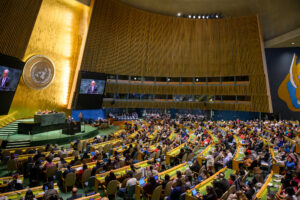
The conference comes just weeks after UN Member States adopted the 2026 Political Declaration on HIV and AIDS during the UN General Assembly High-Level Meeting, reaffirming their commitment to ending AIDS as a public health threat by 2030.
The declaration aligns with the new Global AIDS Strategy 2026–2031, emphasizing country ownership, community leadership, human rights, equitable access to innovation, and sustainable financing as the foundation for the next phase of the global response.
Looking Ahead
The message emerging from Rio is one of cautious optimism.
The data show that decades of scientific innovation, international cooperation, and community leadership have transformed HIV from a global health emergency into a disease that can increasingly be prevented, treated, and managed. Yet the report also underscores that these gains are not guaranteed.
With fewer than five years remaining until the 2030 deadline, UNAIDS warns that sustained political leadership, predictable financing, and continued investment in prevention and community-led programmes will determine whether the world finishes the job—or risks allowing one of the greatest public health successes of the modern era to unravel.
RELATED STORIES:
 Follow SDG News on LinkedIn