More than 180,000 customers in and around San Juan face rotating water cuts as critically low reservoirs, extreme heat and longstanding weaknesses in Puerto Rico’s water system converge.
SAN JUAN — Puerto Rico is beginning emergency water rationing Friday, placing more than 180,000 customers on rotating 48-hour service interruptions as one of the island’s most important reservoirs falls to critically low levels.
The immediate cause is a rapidly intensifying drought. San Juan recorded its driest July in more than 120 years and one of its hottest, while nearly one-quarter of Puerto Rico is experiencing severe drought and substantially more of the island is experiencing some level of drought.
But the emergency is also exposing a deeper vulnerability: Puerto Rico entered the dry period with a water system already struggling with aging infrastructure, substantial water losses and recurring service disruptions.
The New York Times reported Friday on the growing impact of the crisis across the metropolitan region, where an acute shortage of rainfall is now colliding with longstanding questions over the reliability of essential infrastructure.
A Reservoir Crisis Reaches San Juan
The restrictions affect communities supplied by the Carraízo reservoir, including areas of San Juan, Carolina, Trujillo Alto, Gurabo, Juncos, Canóvanas and Loíza.
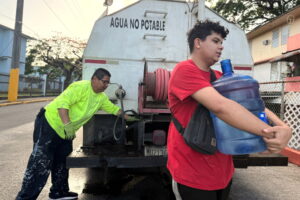
Customers are being divided into zones that will alternate between water service and 48-hour interruptions. Puerto Rico’s Aqueduct and Sewer Authority, known as PRASA or AAA, is deploying water trucks and prioritizing hospitals, elderly-care facilities and other essential services.
Governor Jenniffer González has said there is no firm timetable for when normal service will return. The rationing program is expected to remain in place through at least the end of August, although its duration will ultimately depend on rainfall and reservoir recovery.
Drought Meets a Vulnerable Water System
The shortage is not solely a question of rainfall.
Puerto Rico has struggled for years with leaks and inefficiencies across its water network. Previous assessments by the island’s Financial Oversight and Management Board have found that more than half of the water entering PRASA’s system was being lost through damaged infrastructure and other inefficiencies.
That scale of water loss is part of a broader regional problem. The World Bank estimates that Caribbean water utilities lose roughly half of the water they produce on average through leaks and aging infrastructure. It also notes that treating and pumping water can account for about 40% of utility operating costs, meaning those losses weaken both water security and the financial capacity to invest in modernization.
The comparison places Puerto Rico within a wider Caribbean challenge: maintaining aging water systems while confronting drought, hurricanes, rising operating costs and growing pressure on limited freshwater supplies.
The current emergency therefore reflects two overlapping pressures — an acute shortage of rainfall and structural weaknesses that reduce the system’s ability to absorb that shock.
Little Relief in the Forecast
Federal drought monitors had been warning that conditions were deteriorating well before the latest rationing began.
NOAA’s National Integrated Drought Information System reported declining reservoirs, rivers and groundwater supplies across Puerto Rico following increasingly dry conditions during May, June and July. Agricultural water rationing was already underway in parts of the island, alongside forage shortages, crop stress and reduced irrigation availability.
The outlook provides little immediate reassurance.
Federal forecasts indicate a greater than 70% probability of below-normal rainfall and above-normal temperatures from August through October. Strengthening El Niño conditions could also suppress some of the tropical waves and cyclones that normally deliver important rainfall to the Caribbean later in the year.
That dynamic is particularly consequential for islands whose water systems depend heavily on rainfall and relatively limited freshwater resources.
A Caribbean-Wide Water Security Challenge
Puerto Rico’s emergency also reflects a broader regional concern.
The Caribbean Development Bank identifies water security as a growing development and resilience challenge across the region, where drought, aging infrastructure and climate shocks are placing increasing pressure on utilities and governments.
Some countries are already directing significant investment toward reducing those vulnerabilities. In May, the World Bank approved a $54.7 million water-security program for Barbados focused on modernizing its utility, reducing leakage and improving metering and financial performance. The World Bank estimates that Barbados loses roughly half of the water it produces before it reaches consumers, while demand could rise 30% by 2050.
The example highlights an emerging regional approach: resilience increasingly depends not only on developing new water supplies, but on reducing losses, improving utility management and ensuring that existing supplies reach consumers more efficiently.
Puerto Rico’s Water Resilience Test
Puerto Rico has faced significant drought-related water restrictions before, including in 2015 and 2020. Their recurrence underscores a challenge extending beyond the current emergency: ensuring that essential infrastructure can continue operating through prolonged periods of rainfall scarcity.
The immediate priority is maintaining essential supplies and allowing reservoir levels to recover. The longer-term challenge is reducing leakage, modernizing distribution infrastructure and improving the water system’s ability to withstand future periods of severe heat and drought.
Puerto Rico cannot control when the rain returns. How much water the island can conserve, store and reliably deliver when it does is increasingly a test of resilience — and one facing governments across the Caribbean.
RELATED STORIES:
 Follow SDG News on LinkedIn