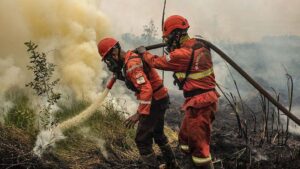
Belgium is battling the largest wildfire in its recorded history, forcing hundreds from their homes and drawing emergency aerial support from European partners as an intense fire season tests the continent’s ability to respond to simultaneous climate disasters.
The fire has burned roughly 3,000 hectares, about 30 square kilometers (11.6 square miles), in and around the High Fens nature reserve near the German border, more than double the roughly 1,400 hectares burned in Belgium’s previous record wildfire in 2011.
Around 600 residents have been evacuated, while more than 250 emergency personnel have been mobilized. The area’s forests, heathland and peat terrain have complicated suppression efforts.
Belgium activated the EU Civil Protection Mechanism, prompting the deployment of three helicopters and two water-bombing aircraft from the Czech Republic, Sweden and the Netherlands. Firefighters from Germany and Luxembourg have also assisted Belgian crews.
The emergency comes amid a much broader European fire season. As of August 12, wildfires had burned roughly 567,000 hectares, about 5,670 square kilometers (2,190 square miles), across the European Union, more than twice the 20-year average for the same point in the year, according to the European Commission’s Joint Research Centre.
That raises a larger question: what happens when several countries need the same limited pool of firefighting aircraft and emergency resources at once?
Europe’s Wildfire Geography Is Broadening
Europe’s most destructive wildfires have traditionally been concentrated around the Mediterranean.
That remains the region of greatest exposure, but recent fire seasons have shown that severe conditions can also emerge farther north, including in Belgium, Germany, the Netherlands and the United Kingdom.
Higher temperatures and prolonged dry periods can make vegetation more combustible and fires harder to control once they begin. But climate is only part of the equation: ignition sources, vegetation, land management, wind and local conditions all influence whether a fire starts and how far it spreads.
Belgium’s record blaze is therefore notable not only for its size, but for what it suggests about wildfire risk broadening beyond Europe’s traditional Mediterranean strongholds.
Europe’s Shared Response System Faces a Tougher Test
Through the EU Civil Protection Mechanism and rescEU, member states can request aircraft, helicopters, firefighters and other resources when domestic capacity is overwhelmed.
For the 2026 wildfire season, Europe assembled 22 firefighting airplanes and five helicopters across 12 countries, alongside pre-positioned firefighting teams.
Those resources have already supported operations in France and Spain this summer, while Belgium is now drawing from the same system.
The framework allows countries to share resources during emergencies, but simultaneous fire seasons expose an inherent constraint: aircraft cannot be deployed everywhere at once.
As dangerous conditions affect larger parts of Europe simultaneously, wildfire preparedness is becoming not only a national emergency-management issue, but a question of European strategic capacity.
Europe Is Expanding Its Prevention Toolkit
The policy response is increasingly moving beyond suppression.
In March 2026, the European Commission adopted an integrated approach to wildfire risk management, linking prevention, preparedness, response and recovery.
That builds on the EU Forest Strategy for 2030, which promotes more resilient forests, and the Nature Restoration Regulation, which requires member states to account for forest-fire risk when implementing restoration measures.
Substantial funding is also available. The Commission has identified approximately €2.3 billion ($2.7 billion) through cohesion policy, €2.2 billion ($2.6 billion) through the Recovery and Resilience Facility and more than €1 billion ($1.2 billion) through the European Agricultural Fund for Rural Development for relevant risk-reduction and resilience measures.
The key question is whether those measures are being deployed at sufficient scale.
What Europe’s Best Practices Look Like
Portugal’s response to its catastrophic 2017 fires offers one prominent model. Its Integrated Rural Fire Management System connects prevention, preparedness, suppression and recovery while combining vegetation management, prescribed burning, grazing, surveillance and landscape restoration.
Portugal and Spain are also using grazing and prescribed fire to reduce combustible vegetation before dangerous conditions develop.
Spain has tested another approach in Riba-roja de Túria near Valencia, where recycled wastewater sustains strategically located vegetation around vulnerable communities, creating green firebreaks designed to slow approaching fires.
Sweden, meanwhile, strengthened coordination among municipal, regional and national authorities after major fires in 2014 and 2018 exposed weaknesses in its response system.
Together, these examples illustrate a broader shift toward managing wildfire risk before ignition, across entire landscapes rather than individual properties, while improving coordination when fires do occur.
What Governments Should Watch
Prevention versus suppression. Expanding aerial capacity is only one part of risk management. Vegetation management, grazing, prescribed burning and more resilient landscapes are becoming increasingly important components of adaptation strategies.
Competition for aircraft. Europe’s shared system faces a harder test when several countries require aerial support simultaneously.
Northern Europe’s preparedness gap. Belgium suggests governments outside the Mediterranean fire belt may need to reassess wildfire exposure, response capacity and evacuation planning.
Landscape-scale resilience. Wildfire does not respect property boundaries. Effective prevention increasingly requires coordination among governments, municipalities and private landowners.
Cross-border coordination. The High Fens fire’s proximity to Germany illustrates why wildfire preparedness increasingly requires international cooperation.
Financing Is Emerging as a Key Question
Europe already has a growing body of policies and practices intended to reduce wildfire risk. A central question is whether prevention and adaptation are being funded and implemented at sufficient scale.
EU Environment Commissioner Jessika Roswall said this month that “prevention is the first line of defence” and warned that no part of Europe can assume it is immune from serious wildfire risk.
For Portugal, Spain and Greece, wildfire preparedness is already a recurring national priority. Belgium’s record blaze suggests that governments farther north may increasingly face similar policy choices.
Strategic Outlook
Belgium’s record wildfire exposes a larger shift in Europe’s climate-risk landscape: the geography of risk is changing faster than many national resilience systems were designed to accommodate.
Europe has built an increasingly sophisticated mechanism for sharing aircraft, firefighters and emergency resources when disasters overwhelm individual countries. But its prevention architecture remains far more decentralized, dependent on national and local decisions over forests, land use, infrastructure and adaptation spending.
That imbalance matters as wildfire exposure broadens. A system built around moving scarce resources to the countries facing the worst emergencies becomes harder to sustain when several countries need those resources simultaneously.
The next phase of European wildfire policy may therefore be defined less by how many aircraft can be mobilized after ignition than by how effectively governments reduce the likelihood that fires become large-scale emergencies in the first place.
For countries historically outside Europe’s wildfire belt, Belgium offers an early test. The question is no longer simply whether northern Europe can experience major wildfires, but whether governments can adapt their landscapes, budgets and institutions before exceptional fires become recurring ones.
RELATED STORIES:
 Follow SDG News on LinkedIn